Shane and Ilya’s Lakeside Cottage Holiday
Heated RivalryShane and Ilya’s two-week stay at Shane’s cottage turns a secluded holiday into a test of whether their private love can survive being spoken aloud and seen by others. The cottage offers them temporary shelter from recognition and the public rivalry surrounding them, but the retreat also brings the relationship closer to the lives they have kept apart: first through an experiment in honesty, then through Shane’s parents unexpectedly seeing them kiss, and finally through a dinner where secrecy becomes a source of hurt between friends.
A refuge built on concealment
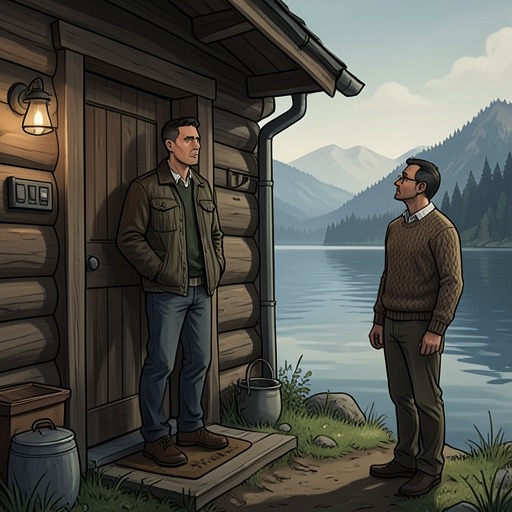
The holiday is arranged around the need to be alone. Shane tells Ilya that the cottage lies far down a private road and that nobody will visit. He has also told his family he needs a couple of weeks of solitude, describing it as a psychological retreat or a kind of mental-training meditation. The explanation gives him privacy without disclosing why the time matters. Their seclusion is therefore both practical and precarious: it lets them set aside the danger of being recognized, but depends on keeping the relationship hidden from the people closest to them.
On the drive, Shane takes one hand from the wheel and reaches for Ilya. Ilya immediately laces their fingers together and squeezes. The small gesture meets the scale of the promise they have made themselves: for two weeks, they can pretend their situation is not impossible. When Shane parks in front of the large, stone-fronted lake house, Ilya is struck by the reality of arriving there. It is much larger than the cottage he expected, but remote enough that he believes he can finally lower his guard. The place offers more than a picturesque change of setting; it briefly alters what they can safely do and feel in one another’s presence.
Speaking, listening, and imagining a future
The emotional opening of the holiday has a precursor in a phone call. Shane answers immediately and asks how Ilya is doing before exchanging greetings. Ilya can only say that he feels bad. When Shane asks about his family, Ilya does not give him a clear account in the available exchange. Instead, Shane proposes that Ilya say everything he wants to say in Russian, even though Shane will not understand, because speaking might help. After a silence, Ilya agrees. For several minutes he speaks with an animation and fluster Shane has rarely shown before; Shane sits on the stairs and listens. The exchange makes attention, rather than comprehension, the form of care: Ilya is allowed to speak without translating himself for Shane.
At the cottage, Shane proposes a more direct version of that same listening. For the two weeks, they should be honest about what they are thinking and how they feel. Ilya cannot bring himself to say what he fears: that honesty might make him seem pathetic, or that Shane might return his feelings and leave them facing an even harder question. He answers that he will try. The hesitation matters. Their agreement does not erase the risks between them; it makes those risks the subject of the time they have set aside.
The holiday also gives their ordinary closeness room to register. At a bonfire Shane has suggested, Ilya sits pressed against him on a small bench made from a chunk of tree. The chilly air and warmth of the fire make an evening Ilya initially finds unpromising feel less terrible. He asks after Shane’s head, because Shane has complained of a headache and said such headaches have been common since his injury. Care here is reciprocal and unceremonious: Shane creates a scene he is excited to share, and Ilya notices the injury that continues to shadow him.
The next morning, over coffee on the deck, Ilya considers whether playing for a team outside Boston might reduce the burden of their rivalry. Shane agrees that they would then play each other only twice a year. Neither likes what the solution would cost. The exchange exposes the tension inside the practical calculation: fewer confrontations might make the relationship easier to conceal, but fewer games would also mean fewer chances to see each other. Meanwhile, Shane’s wish for Ilya to meet his parents has become an idea he thinks about constantly, though he cannot explain why he wants it when he also recognizes it as an absurd and terrible prospect. The cottage’s promise of solitude thus coexists with a pull toward family life beyond it.
The secret becomes visible
That tension breaks when Shane and Ilya kiss on the deck. The kiss is slow and deliberate; Ilya holds Shane close, and Shane feels dizzy with happiness at being loved in the place he loves most. A noise interrupts them. They turn and find Shane’s father standing inside the house, frozen as he watches them wrapped around each other. For a moment nobody moves or speaks. Shane’s father then turns toward the front door, and Shane lets go of Ilya in alarm.
When they go to Shane’s parents’ home, he enters without knocking, as he never does with them. His parents rise from the couch, and it is clear that his father has already told his mother what he saw. His mother repeats Shane’s name as if she can hardly recognize it, and Shane says they should talk. The accidental discovery converts the cottage from a protected space into the point from which Shane’s private relationship must be addressed directly with his family.
The response is not uniform shock for long. Shane’s eyes blur as he says he wants the same thing as Ilya, and Yuna covers her mouth before clapping her hands, standing, and immediately asking what the plan is. She frames the situation as a problem to solve and asks whether Shane has spoken to Scott Hunter. Shane gives Ilya a small smile: Yuna is now on their side, and he cannot imagine a better ally. Her instinct to act does not remove the difficulty of the disclosure, but it gives the couple practical support at the moment their secrecy has been breached.
Secrecy’s cost among friends
The holiday’s consequences extend beyond Shane’s parents. At a dinner with Hayden and Jackie, Shane’s anger finally breaks through. After Ilya has refilled his wineglass several times, Shane says he has been frightened and alone for a long time and that the evening was supposed to end some of that loneliness; he condemns both men for behaving like children. The outburst turns the concealment that protected the couple into something their friend experiences as exclusion.
Hayden answers that Shane could have told him, and says he hates that Shane kept the relationship hidden and believed he had to. He later recognizes that he has made the dinner about himself, apologizes for spoiling an important evening, and accepts Shane’s thanks. He also tells Ilya that if Shane loves him, Ilya cannot be such a bad person. Jackie’s brief reminder of her presence keeps the confrontation from becoming a private exchange between the couple and Hayden alone. The scene does not make secrecy disappear; it shows its emotional bill being paid in a friendship, followed by the possibility of repair.
Across the two weeks, the cottage therefore functions less as an escape from reality than as a temporary place to practice a different one. Shane and Ilya can hold hands, speak more honestly, and imagine alternatives to the rivalry’s constraints, but they cannot keep the outside world entirely beyond the private road. Shane’s father’s discovery and Hayden’s hurt bring family and friendship into the story of the relationship. The retreat’s significance lies in that movement: its refuge allows the couple to become more visible to one another, while also bringing them closer to being known by others.